Your contractor gives you a quotation — forty window options, three price brackets, and no clear answer on why a single frame casement window is priced higher.
So you pick what looks nice, costs less You move on.
That five-minute decision will affect how your home breathes, seals against rain, and holds up through the next two decades — and most homeowners never find out what they got wrong until something starts rattling in year three.
At Ostenta Decor, we started this Knowledge Series for exactly that reason. So before you finalise your casement window order, here are five questions worth understanding deeply.
What is single frame casement windows?
Q1: What is a single frame casement window and what makes it different?
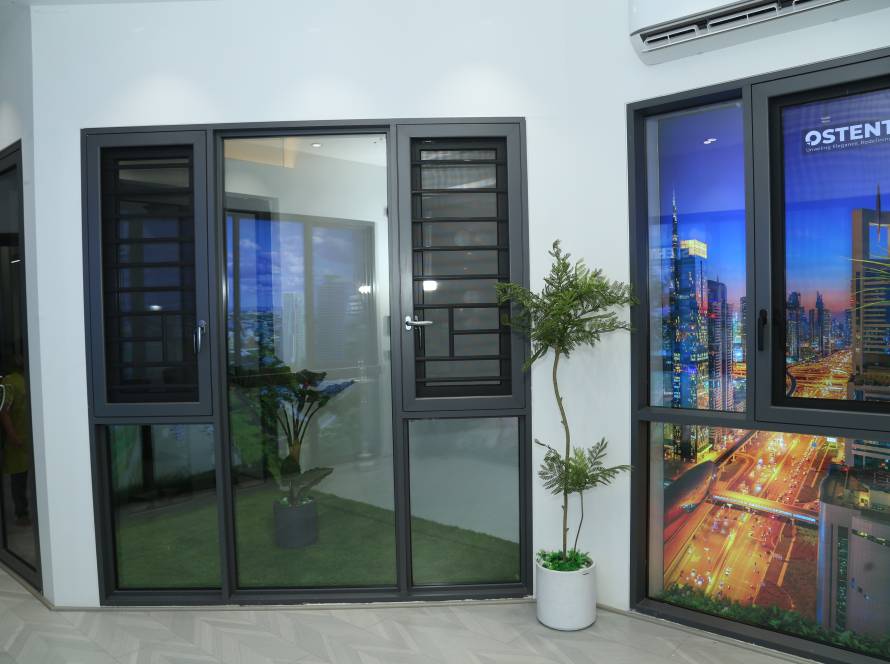
A single frame casement window means the glass panel, the grill, and the mosquito net all three components are integrated into one single frame.
This is different from windows where each component has its own separate frame that gets joined together on-site during installation.
Think of it like a bridge cast as one continuous structure versus one built from separate sections bolted together. You don’t notice the difference — until the load increases.
Q2: Why is a single frame window priced higher than what other multiple frames?
This is one of the most important questions to understand before comparing quotes.
When a supplier quotes you a lower price, it is usually because they are using thinner aluminium profiles, lower-grade hardware, or separate frames that get joined on-site instead of a factory-built single unit.
A genuine single frame window costs more because:
- The aluminium profile has to be designed and extruded to accommodate all three components ( glass, grill, and net ) within one section. This process requires more precision engineering.
- The hardware — hinges, handles, locking mechanisms — has to be rated for the full weight and width of the assembled unit, not individual lightweight parts.
- Factory fabrication takes more time and skill than simply joining separate pieces on-site.
What looks like a saving today often costs you in quality — the same quality that decides how long your window lasts and how well it performs.
| At Ostenta Decor, every casement window we build is a single frame unit. Not because it is premium — but because it is the only way to guarantee the structural integrity and finish quality our customers expect. |
Q3: Why do professionals always recommend single frame — even when the result looks almost same?
The difference between single frame and multi-frame is not visible to the eye, on day one. It becomes visible over time — and by then, it is expensive to fix.
When separate frames are joined on-site, each connection point is a potential weak spot. These joints are exposed to wind pressure, thermal expansion (aluminium expands and contracts with temperature changes), monsoon rain, and the vibration of daily use.
Over time, these joints loosen. Gaps appear. Water seeps in. The mosquito net frame starts rattling. The grill section shifts slightly — causing an alignment problem you’ll notice every time you try to close it properly. None of this happens overnight — but it is happening quietly.
A single frame has none of these joint points between components. The glass, grill, and net all move within one rigid, sealed system. There is nothing to loosen, shift, or gap.
This is why architects and experienced contractors who understand the product will always recommend to use single frame — even when the client’s budget is low. It is not about premium versus budget. It is about getting the basic engineering right.
Q4: Single frame vs. multi-frame — what actually changes in your day-to-day experience at home?
Here is what the difference actually feels like to live with:
| Factor | Single Frame | Multi Frame |
| Structural strength | One unit — no weak points | Joints loosen over time |
| Monsoon performance | Tight seal — water stays out | Gaps at joints let water in |
| Noise on windy nights | Silent — sealed as one system | Rattles at connection points |
| Mosquito net & grill fit | Factory-precise — moves smoothly | Can misalign after installation |
| Appearance | Clean, seamless finish | Visible joints and overlaps |
| Long-term durability | 20+ years with minimal upkeep | Repairs likely within 3–5 years |
| Overall value | Higher upfront, lower lifetime cost | Lower upfront, higher lifetime cost |
These are not dramatic failures. They are small daily irritants that add up — and that remind you, every single day, of a decision made in five minutes.
Q5: How do I know if the single frame window I am being sold is actually built right?
This is the question most homeowners never think to ask — and the one that matters most at the point of purchase.
The good news? You do not need to be an expert to protect yourself. You just need to ask the right questions.
Not every supplier who says “single frame” delivers the same quality. Here is how to verify before you commit:
- Ask to see a sample section of the aluminium profile. It should feel solid and have adequate wall thickness — not hollow or thin when you tap it.
- Check that the grill and mosquito net operate smoothly within the same frame — without any separate outer border or secondary attachment.
- Ask what hardware brand is being used for the hinges and locking mechanism. Quality hardware is rated for the full weight of the unit and is resistant to corrosion.
- Ask whether the window is fabricated in a workshop or assembled on-site. A true single frame unit is always factory-fabricated.
- Ask for a warranty on both the product and the installation separately. A supplier confident in their work will offer both.
| At Ostenta Decor, we encourage every customer to ask us these questions directly. When you understand what you’re buying, you make a better decision — and that’s something we’re always happy to support. |
Final Thoughts
A casement window is not a complicated product. But the difference between a well-built single frame unit and a cheaper alternative is one of those things that reveals itself slowly — in the quality of your sleep on a windy night, in how your home feels during the first monsoon, in whether you are calling for repairs in year two or year twenty.
Single frame is not an upgrade. It is the correct way to build a casement window.
Every casement window we build follows this principle. Not because it is premium, but because it is the approach we trust for long-term durability and performance, regardless of the compromises often made in the pursuit of lower costs.